
Working Knowledge
Is it really clever to spend too much time thinking?

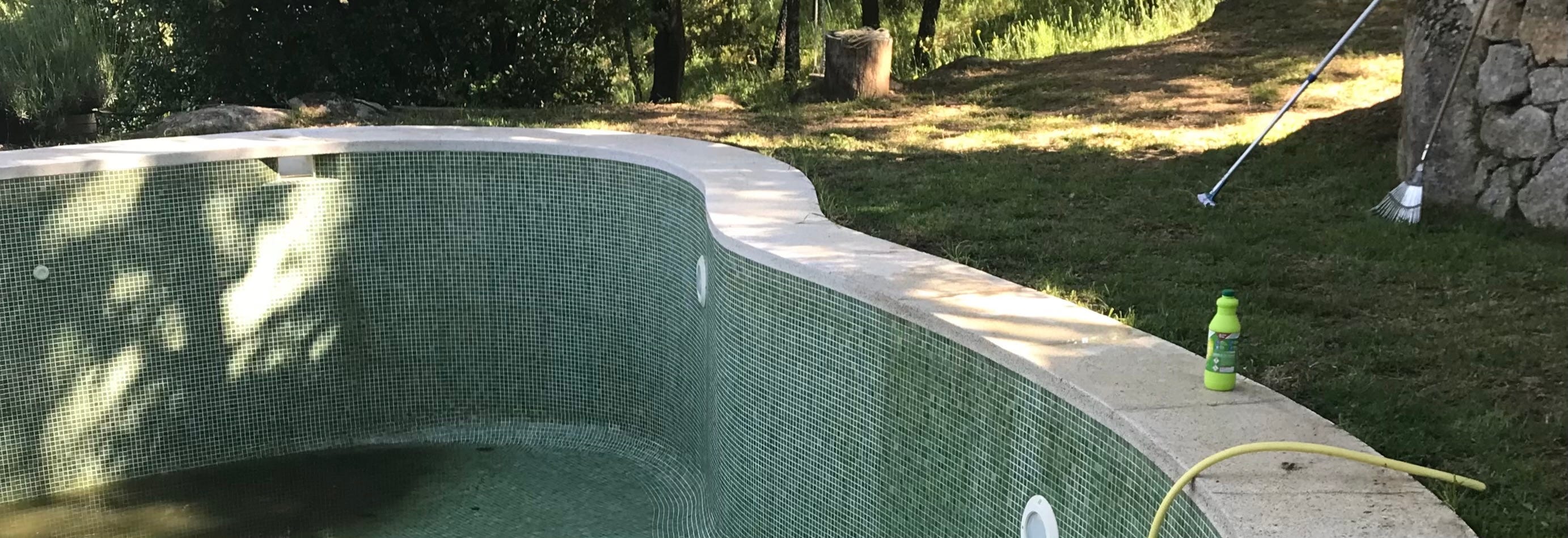
Just at the death, with only the last murky, muddy dregs of water left in the bottom of the pool, the pump jammed. I had made mistakes before, and expensive ones at that, so as soon as the pump started to protest I switched it off as quickly as I could. It had been working fine for the best part of an hour and then suddenly, it wasn’t. What had happened? What had I done wrong? What to do now?
I reasoned (or perhaps simply hoped) that it couldn’t have burnt out in only a few seconds. Once before I had left the pump unattended with a crucial valve closed, but it took a few minutes to burst the pipes and immerse the electronic equipment in a fatal flood of salt water. This seemed different but in my ignorance how could I possibly know? I felt stupid. Frustrated. Depressed. Trapped.
I needed help, but Ivan, the guy who built it and knows how it all works, was ignoring my calls - at this time of year he is incredibly busy and hopelessly unreliable. A plumber perhaps? My plumber’s name is Angel and when I have needed him urgently before he has behaved like one. I didn’t want to jeopardise that; plumbers quite rightly give priority to people who have no water (or too much in the wrong place) and since our house is off-grid in a remote rural area, there would come a day when I would really need him, to stop a leak or remove a blockage. Today was not that day.
The dumb solution would be to buy a new pump. I found the manufacturer online. There were a clutch of models that all looked the same but had different technical specifications. Could I trust myself to get the right one? Even if I did, it would cost hundreds of euros, take the best part of a week to arrive and I would still need to find someone to install it. Moreover, since I didn’t know what had caused the problem how did I know that a new pump wouldn’t also fail?
So I asked Pedro. Pedro is a gardener by trade but helps me out with all sorts of odd jobs. He knows how to build a stone wall or prune a cherry tree and it turns out he knew enough about pumps and pools to have an idea of something we could sensibly do. He was happy to disconnect the pump because he knew how to connect it again. More importantly, he knew that he knew enough to do so.
He also knew that having been out of use for nine months, there was a good chance that the pump had just seized up, which was why he suggested it. He knew that you could check this by taking off the cover at the back and trying to rotate the vanes attached to the pump shaft by hand. So we did just that and discovered that this was precisely what had happened. The pump was stuck but it hadn’t burnt out. With a bit of force we could start to shift the vanes by hand and with the help of some penetrating oil, we were able to get them moving freely.
This was enormously satisfying - there’s nothing like fixing something you think is beyond you - but it also got me thinking about how knowledgeable someone like Pedro, who works with his hands outside all day, really is. Yet we would never call him a ‘knowledge worker’.
The term ‘knowledge worker’ was coined by Peter Drucker in 1959 in his book ‘Landmarks of Tomorrow’. He used it to describe individuals whose primary job involves handling or using information rather than manual labour. His view was that such kinds of work would become much more important. The idea of ‘knowledge work’ became something to aspire to, a superior form of modern, even futuristic work. In the 1990’s the term gained traction, along with Charles Leadbetter’s notion of a frictionless world of informational exchange that he called the ‘weightless economy’.
It seems to me that such images miss something important about the nature of work. I very much enjoy thinking, talking and writing and on occasion, get paid for it, so I am myself a ‘knowledge worker’.1 Yet even so, if I spend too long thinking, talking and writing, particularly if I am doing so on-line, it makes me feel icky.
I get fidgety and flighty, distracted and disperse. Everything feels frothy and I lose the capacity to concentrate, if not the will to live. I make endless mental lists which I never even write down on an actual piece of paper before I go careering off onto the next one. My mind rushes around like a chicken, pecking madly at anything.
Abstract work lends itself to becoming untethered. Philosopher of technology Tom Chatfield is fond of pointing out that much of modern work consists of “trying to move things out of your own inbox and into other peoples’”. My friend and colleague Johnnie Moore made a similar observation as we came out of the London offices of a large corporation. He noticed that a lot of what we had just observed (in a meeting with senior leaders) seemed to consist mostly of “passing the parcel of anxiety around, so someone else has to deal with it.” Nick Parker, another friend who is also a writer, once described the work of accountants as “high concept drudgery”.
To me, these all feel like consequences of the fact that ‘knowledge work’ is, by definition, abstract. An email has no heft: it does not need to be crafted out of wood or stone. Moving something effortlessly into someone else’s inbox might feel great - until you realise that it takes no effort for someone else to move it back again, along with a host of other things. Clicking ‘reply all’ seems to come at zero cost - until everyone does the same and you are bombarded with yet more noise and distraction.
When all you have is numbers, words or ideas in mind, there is nothing tangible at hand. How you are judged depends upon the image that other people casually construct of you, based on their own particular interests and interpretations. Being constantly at the mercy of what other people think about you is a downside of the abstraction of a ‘warts and all’ person into a ‘personal brand’.
By contrast, as the story about Pedro illustrates, there is more to manual work than brute force. Working on a production line in a factory in the late 1950’s may have been mindless and repetitive but Pedro’s kind of manual work is steeped in knowledge and information, plenty of which is subtle and intricate. He doesn’t talk about what he might do or write a ‘think piece’. He starts by starting and learns through action. He works physically, with plants, pipes, pumps, locks, or fire - not to mention his own body. He clears, plants, weeds, fixes, mends, invents, builds and creates using cement, earth, bricks, wood, sticks and dozens of other materials, bought or found. He might wield a spade, an adze, a hammer, a nail, a chisel, a drill, a lever, a counterweight or some other improvised tool in the pursuit of a solution he can see (or feel) in his mind’s eye, drawing on experience, memory and imagination as much as physical effort. He weighs up alternatives, sets priorities and designs a process to get the work done even as he is doing the work itself. This requires skill of hand, eye and brain. It both draws upon and engenders a huge amount of knowledge, of different kinds, including the tacit and embodied.
I recently met Jennifer Garvey Berger at a conference where we were both speaking. Jennifer is known around the world for her work on leading in complexity. We were talking about the moment where ‘your work’ takes on a life of its own and people start to refer to it as something separate from you. Laughing, Jennifer said “I don’t really know what that is, all I have done is a whole lot of talking”.
This seems like a much healthier way to describe it. Talk is not nothing, indeed I have myself described conversation as an ‘everyday miracle’ but to think that we can become abstract beings, doing purely informational work in a weightless economy presumes we are disembodied minds and excludes most of the struggles and joys that we care about.
I may get paid for what I know, but I feel better if during the course of a day or a week, I do different kinds of work that require different kinds of knowledge. And that is something I just know in my bones.
The weakness of this argument is that it assumes that some of what I do qualifies as ‘work’ which a good number of friends and family members would question.
Thanks Tim.
Thanks Gavin. Lovely reflections.